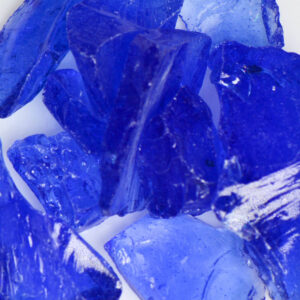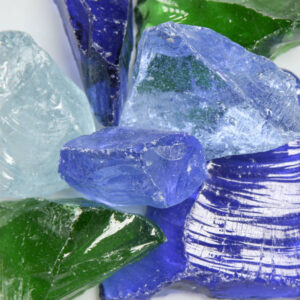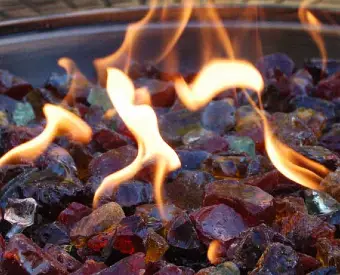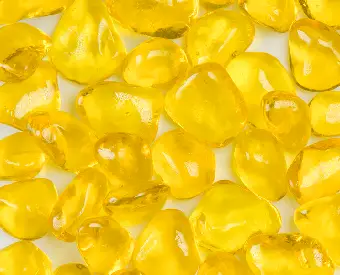
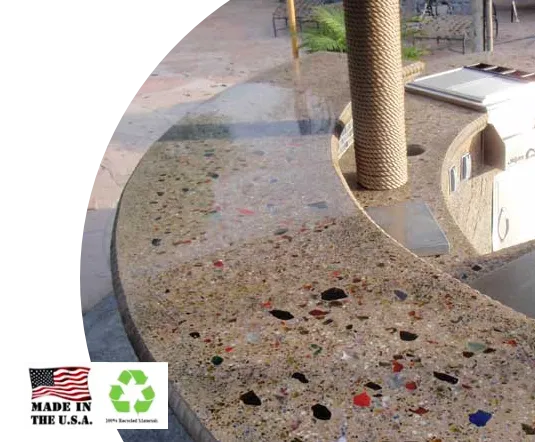
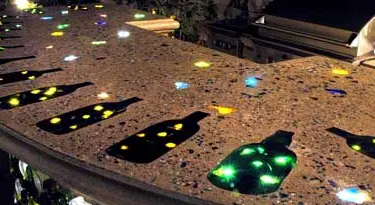
How to use ASG Glass glass chips in DECORATIVE CONCRETE (See PDF)
Variations in the use of ASG Glass glass chips in decorative concrete are limited only by a user’s imagination. How the glass is applied, the quantities of glass used, and the mixes of
colors chosen can provide a unique and signatured decorative concrete product for thoseup to the challenge.
The most common applications of glass in decorative concrete are (1) seeding and (2) mixing integrally. First, the seeding concept:
Seeding glass means sprinkling, broadcasting, or spreading glass onto the surface of a concrete floor, slab, or other surface. The advantage of seeding glass is that the quantity of glass used is reduced relative to other methods. Also, you can continue to use a traditional 6-bag or other traditional concrete mix that you’re used to and simply add the glass as a decorative accent to your project surface. The disadvantage to seeding is that it’s tricky to uniformly spread the glass on your concrete surface.
The steps involved in seeding glass are fairly straightforward:
- Prepare and place your concrete as you normally do.
- Bull float the concrete to smooth out the surface, but don’t rough trowelor finish trowel your project.
- Spread the glass out evenly on your concrete surface using whatever quantity, colors, and mixes of glass that you desire.

- Lightly trowel the glass into the concrete gently pushing the glass into the
still wet concrete mixture. Take care not to push the glass too far in or
your finishing, grinding, and polishing process will take longer. Leave
Pea gravel, compacted substrate
some of the higher glass tips on the surface or even sticking out of the
concrete.
- Allow the concrete to cure for approximately seven days, depending on
atmospheric conditions. Attempting to finish the surface too early will
damage the surface. Finishing the surface too late will take much longer
and will put undue wear on your finishing tools.
Note: From here, finishing methodologies differ by desired outcome of
the project. Exposed aggregate, sandblasting, and other finishes are
possibilities. We most frequently get questions about grinding, polishing,
and sealing, so we’ll proceed assuming that that finish is your desired
result.
- Begin grinding the concrete surface with a 50 grit diamond grinding pad
or similar taking care to wet the surface during the entire grinding
process. Wetting the surface reduces the friction between the pad and
the concrete reducing scratching and scarring of the concrete. (The glass
grinds uniformly with or without wetting.) Increase to a 100 grit, then
200 grit, and continue doubling the grit until you achieve the finish and
polish you desire.

- Sweep, vacuum, and/or wash the surface (often with muriatic acid) to
remove the finishing dust from the grinding and polishing process.
Install the sealer of your choice carefully following the manufacturer’s
recommendation be it a shiny UV-resistant or a flat penetrating sealer.
TIP 1 - Before step 3, some people use a retarding product on the surface to increase the working time. We haven’t had experience with this step, so
we highlight it simply as a consideration.
TIP 2 - Use of an acrylic fortifier to the concrete mix helps with the adhesion of
the concrete to the glass and other aggregates. Acrylic fortifiers can be
found at any concrete supply place (including aisle 1 at Home Depot)
and looks like a heavy milk or a liquid Elmer’s glue. Not required, but
helpful.
The second most common application is integral mixing. Integral mixing means replacing
all or a portion of the aggregate in a concrete mixture with recycled glass chips. If you
have your own proprietary mixture, simply subtract your original aggregate (pea gravel)
amounts by weight by the amount of glass added to your mixture. The advantage of
mixing integrally is that the glass aggregate mixes uniformly in the batch of concrete and is
obviously uniformly segregated in the finished concrete product. The disadvantage is that
much more glass is needed in a batch of concrete relative to seeding/broadcasting.
- Replace traditional aggregate content with ASG Glass recycled glass
chips on a one-for-one basis by weight. That is, if a traditional 6-bag
mix requires 100 lbs of aggregate per batch, replace all or a portion of
the 100 lbs with glass. Mixing aggregate and glass 50/50 or any other
percentage is fine. More glass provides a more colorful finish, less glass
a more subtle color.
- Mix, pour, bull-float, rough trowel, and finish trowel the concrete.

- Follow steps 5, 6, and 7 above by allowing the concrete to cure,
grinding and polishing it to the finish you desire, then sealing it with a
good sealing product.
TIP 1 -
We always recommend adding our fine glass (ground glass minus 30
mesh) to your mixture when glass aggregates are used. The silica in the
fine glass chemically reacts well with the cement to better bond the
concrete mixture to the glass. An acrylic fortifier helps as well, but the
fine glass is highly recommended in this case.
TIP 2 -
We’ve used in the past a mixture as follows and have had reasonable
success in limited applications:
Portland cement ................................ 25% by weight (plus a little more)
Glass fines ......................................... 25% by weight
Glass chips (sizes #00 and #0) ........... 25% by weight
Glass chips (sizes #1, 2, and #3) ........ 25% by weight
Acrylic fortifier................................... Per manufacturer’s recommend
TIP 3 - We don’t recommend using our glass as a coloring agent. There are
numerous companies that make concrete coloring products that will
serve you much better than our products. Our fine glass is lighter in
color and provides only a subtle color change rather than the deeper
color change most customers seek. Our glass is great for subtle effects,
not so great for deep effects.
|